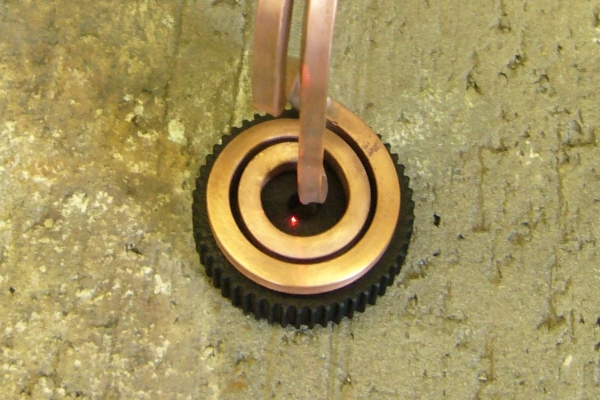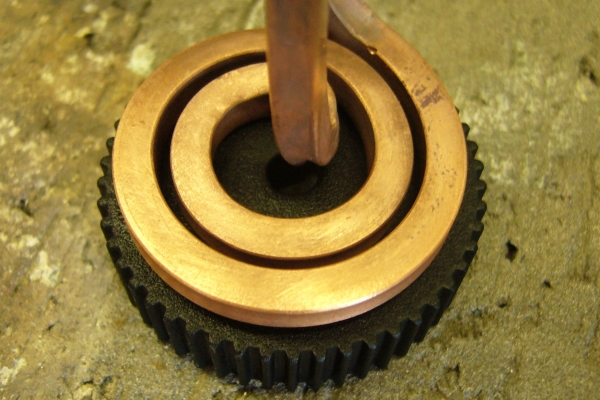
Adhesive bonding
Inductive bonding is primarily used in the automotive industry, for example in the bonding of hoods or doors. However, relevant applications can also be found in electrical engineering and the household appliance sector.
In these applications, the advantages of induction heating become clearly evident — particularly in terms of short heating times and high precision.
How induction bonding works
Many modern adhesives cure or activate through targeted application of heat. Induction heating brings the heat directly into the adhesive joint or the adjacent metallic component, instead of heating the entire assembly in an oven. This significantly shortens curing time and protects temperature-sensitive components and coatings around the bonding area.
Advantages over oven and hot-air processes
- Short cycle times – the adhesive joint heats up quickly and locally, whole assemblies do not need to be heated through
- Protection of sensitive components – paint, plastics and electronics near the bonding area stay cooler
- Reproducible process control – temperature and heating time can be precisely controlled and documented
- Good integration into series production – suitable for automated cycle stations as well as manual workstations
Typical applications
Induction bonding is used, among other things, for joining body panels such as hoods, doors and fenders, for bonding metal and plastic components in household appliances, and for electrical assemblies that require fast, locally confined heating.
FAQ on induction bonding
Which adhesives are suitable for induction bonding?
Suitable adhesives are heat-curing or heat-activated types that respond to a defined activation or curing temperature. We match the right combination of adhesive, inductor and process parameters to your application.
Why is induction bonding faster than oven curing?
Because the heat is applied directly to the adhesive joint or the adjacent metal component, instead of heating the entire assembly in an oven. This shortens curing time and saves energy.
Can induction bonding be automated?
Yes. In addition to manual workstations, we also implement automated bonding stations with PLC control that can be integrated into existing production lines.
Planning a bonding application? Talk to us – we will show you, based on your component and adhesive, how the process can be implemented inductively and economically.